Peter Baye found several beautiful native wildflowers in bloom along the Gualala River recently. He wrote, “The tiny flowers of wild heliotrope are appearing on gray-green mounds of plants that regenerate from eroded roots in cobble-gravel bars each year. Some have beautiful contrasting darker purple centers. They also grow on the coast around some sandy lagoon shores and bluff seeps, but completely prostrate."

And one of the more uncommon riparian plants on the Gualala River is in bloom: wild licorice, Glycyrrhiza. It also follows stream orchids along bedrock and boulder banks upstream, in a few places. It has a sweet root, but no anise ‘licorice’ candy scent.”

Thanks to Peter for allowing me to share his photos with you here.

It was foggy this morning but the sun broke through this afternoon. Temps in the low 60's. Lots of visitors to the coast this holiday weekend!

Happy Independence Day to those of us in the United States!


2 Comments

A walk along the Gualala River is certain to bring you great sightings and joy. Ron Bolander had discovered a group of willow trees, we think Sitka willows, that red-breasted sapsuckers were drilling holes – called wells – in the bark to get the sap. Other creatures then use these wells to feed, so the sapsuckers are important for the ecosystem. Ron invited Shari Goforth and me to take a hike with him on Saturday to see the show.

While walking on the cobbles by the river, we saw a tiny Sierran treefrog, normally colored emerald green, which was colored tan to match the stones. It was so well camouflaged that we kept losing sight of it.

When we came to the willow trees, we watched from a distance as a red-breasted sapsucker appeared, the male. Some minutes later the female arrived. Ron told us there must be a nest nearby. When the sapsuckers were gone, other birds moved in to feast, including Anna’s and Allen’s hummingbirds. A Wilson’s warbler stopped by, perhaps eating insects in the sap. Then several beautiful butterflies appeared, a satyr comma and a mourning cloak, and fed. It was quite wonderful to see.

The next day, Sunday, Ron returned to the same place and found two red-breasted sapsuckers on the willow trees, but this time one was a fledgling, perhaps just out of the nest!

A bonus photo from Shari of one of the adults flying straight at her.

Thanks to Ron and Shari for allowing me to share their photos with you here.

Quite foggy here today, but sunny up on the ridge. Temps in the 60's. With those heat domes in the eastern part of the US and in Europe, we're not going to complain about the cooling fog.

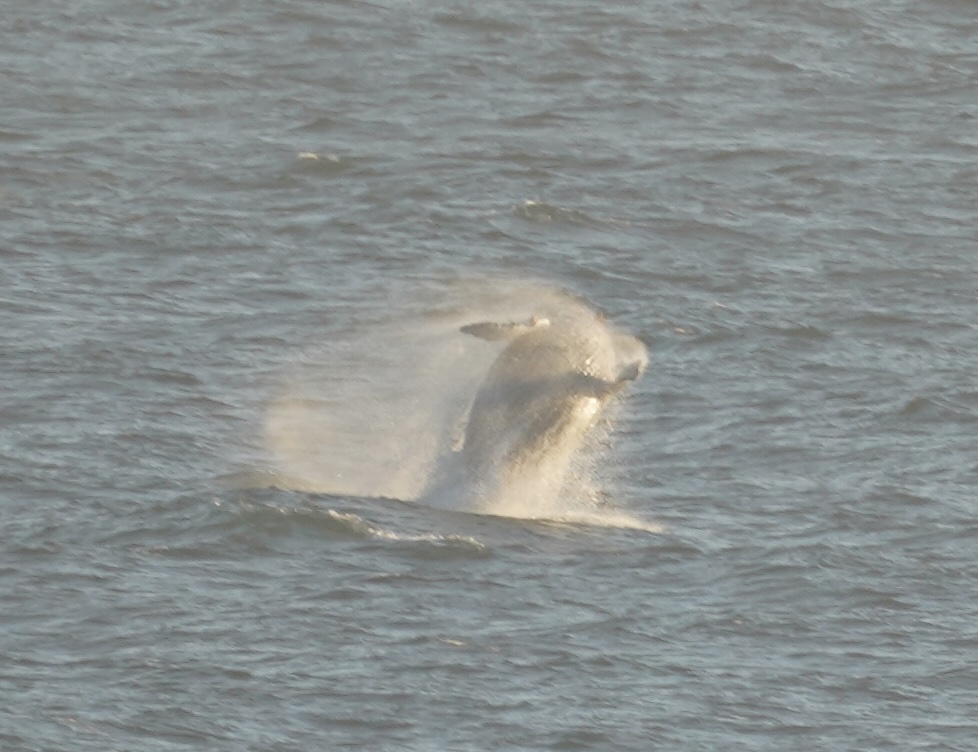
Ben wrote, “I saw at least two Humpback Whales a ways out. They were feeding, swimming in circles, possibly bubble netting a bait ball. I was able to catch them by following the birds.”

There’s a good clue here – follow the birds. Brown Pelicans, Gulls and other birds will often be at the seafood buffet where the whales are feeding.

Thanks to Ben for allowing me to share his photos with you here.

It's sunny today but very windy! No spotting whales this afternoon - the ocean is full of white caps!

Michael Reinhart recently got this great photo of a Spotted Towhee singing.

Can you hear it? Maybe this will help. Here's a link to the Cornell Lab of Ornithology: https://www.allaboutbirds.org/guide/Spotted_Towhee/sounds

Here's what Cornell says about this bird's call: "It lasts about 1.5 seconds. The song starts with one or two (up to eight) short introductory notes and then a fast trill that can sound like a taut rubber band being plucked, or a piece of paper stuck into a fan. Some Spotted Towhee songs have just the trill phrase only."

Thanks to Mike for allowing me to share his photo with you here.

It's warm and breezy today, with a big fog bank lurking over the ocean. Yes, we did have an earthquake on Wednesday morning. It was fairly mild here - two seconds of shaking. No damage except to our nerves!


Can you hear it?

2 Comments

Last Saturday, young Oly Perket saw fire in the blue sky. She wrote, “This was taken when Mom [Madeline Perket] and I were driving to Sebastopol.”

Oly photographed a beautiful atmospheric phenomenon called a circumhorizontal arc. They are often called fire rainbows, except they aren’t actual rainbows.  They are ice halos created when sunlight passes through high-altitude cirrus clouds.

Thanks to Oly for allowing me to share her photo with you here.

Foggy morning, sunny afternoon with temps in the 60's. It's the last day of spring!